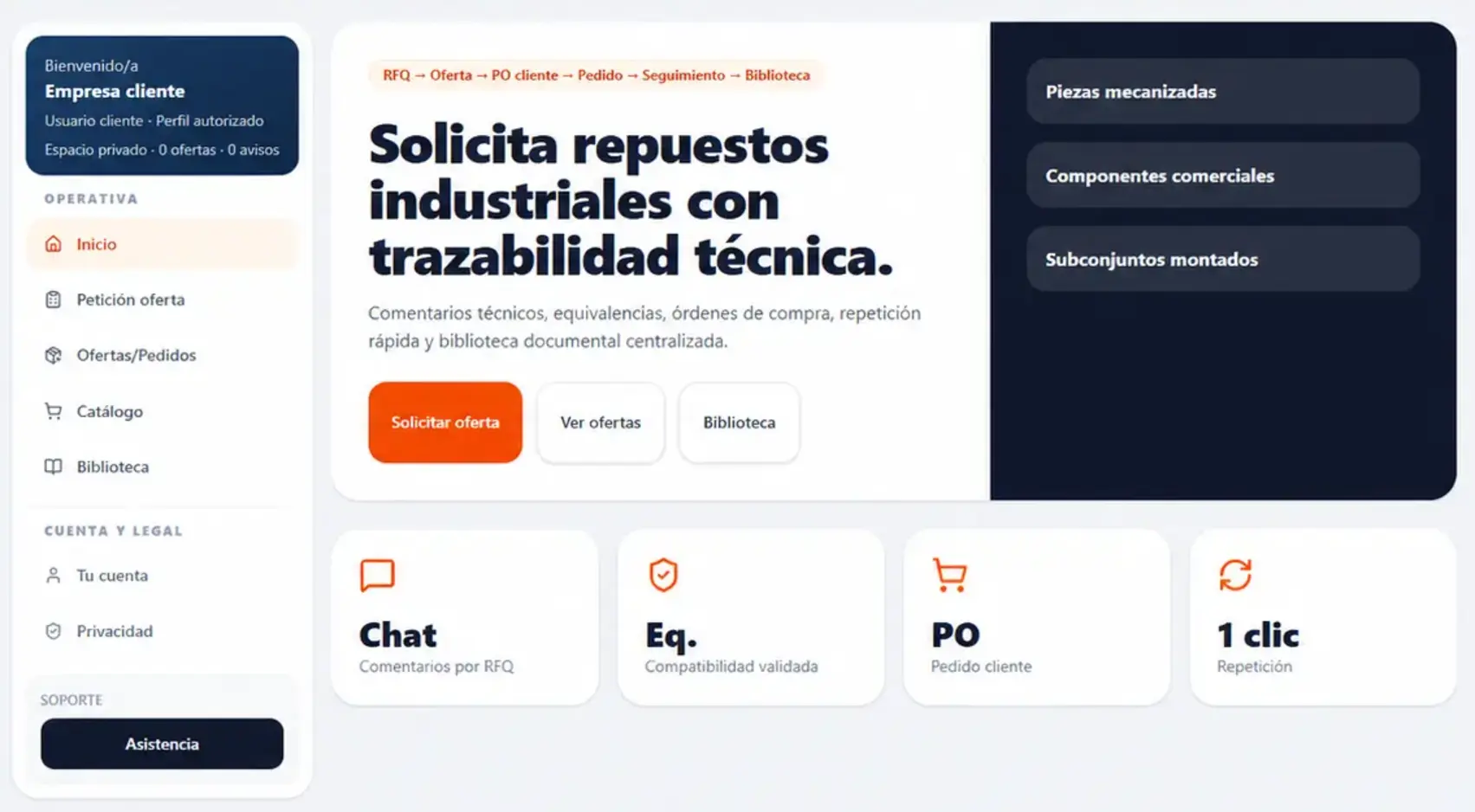
A platform rooted in real operations, designed to make industrial spare-parts purchasing and reordering traceable from the initial need to the next replacement.
SECTORIndustryMY ROLEProduct and operationsSTATUSContinuous evolution
An industrial spare-parts request is not a normal online purchase. It may concern a commercial component, a custom part made from a drawing or sample, an alternative to an obsolete item or a complete assembly. Technical information, suppliers, quotations, dates, documents and decisions all need to survive until the next reorder.
The problem was not simply to “build a shop”. It was to prevent context from breaking between the initial email, technical review, purchase, supply and the future need for the same part.
REAL RESPONSIBILITY
Product thinking connected to operations.
I work within the service and translate customer and team needs into flows, fields, statuses and priorities. I define functional behaviour, validate real cases and decide what must be solved now and what can wait.
WHAT I DO NOT SHOW
Confidentiality before spectacle.
This case shows the journey and selected customer views. It does not publish prices, company data, documents, credentials or internal administration panels.
The process the platform needed to keep connected
01
Request
The customer describes the need, attaches drawings or references and defines priority, required date and assembly type.
02
Technical review
The team studies specifications, searches for suppliers or alternatives and identifies missing information before quoting.
03
Quotation and order
The proposal centralises options and, once approved, keeps the technical context attached to the order.
04
Supply
The commercial or manufactured part is controlled, documented and prepared against the agreed requirements.
05
Identification
A Comanai reference connects the part, packaging, documentation and history to improve traceability.
06
Reorder
When the part is needed again, the customer can recover its context without rebuilding the purchase from scratch.
How the solution evolved
STAGE 01
Understand before building
Map the real journey, spare-part types, minimum information and the points where context was lost.
STAGE 02
Create the essential flow
Connect request, priority, required date, attachments, review, quotation and order as one sequence.
STAGE 03
Test the exceptions
Urgent requests, partial or total assemblies, incomplete references and parts requiring manufacture or an alternative.
STAGE 04
Build continuity
Catalogue, order library, documentation, invitations, permissions, notifications and reordering evolve as modules.
Product decisions that reduce risk
01
Private portal
Requests, quotations, orders, catalogue, documents and communication through one access point.
02
Traceability
Technical information follows the part instead of being reconstructed at every stage.
03
Simple reordering
History and documentation make future replacements easier to recover.
04
Roles and permissions
Each type of user sees only the functions and information they need.
05
Modular foundation
Orders, user invitations, notifications and tracking can evolve in priority order.
06
Useful design
Priority actions appear before the system's internal complexity.
DEMONSTRABLE OUTCOME
I will not invent a number we have not measured.
The verifiable outcome is structural: requests, specifications, quotations, orders, documents and references stop being isolated fragments and become part of the same history. That makes context easier to recover, purchases easier to repeat and the platform easier to evolve without rebuilding the workflow.
One entry point for different types of request.
Technical information connected to each request and order.
A reference linking part, packaging and history.
A modular base for priority-led evolution.
WHAT THIS SHOWS ABOUT MY WORK
My contribution is not limited to programming screens. It is understanding an operation that was not originally digital, separating rules from exceptions and turning it into a product the team can use and grow.
THE IDEA YOU CAN APPLY
Custom software makes sense when it connects a process that generic tools force you to fragment.
Does your company work across too many disconnected tools?
You do not need to arrive with a defined solution. Tell me how you work and we will decide together what can be done, what is worth doing and what is not.
First 20-minute conversation, free of charge · reply within 1–2 business days.